

Rose breeding is one of the most demanding disciplines in horticulture, where success depends on patience, precision, and an uncompromising attention to detail. From an agronomical perspective, it requires years of controlled selection, strict plant health management, and stable growing conditions to allow genetic potential to fully express itself. From a business perspective, it is a long-term investment, often taking seven years or more to develop a single viable variety where quality, consistency, and risk management outweigh speed.
It is within this delicate balance of science and strategy that United Selections operates, leading the game in breeding roses in Kenya under conditions that protect innovation with strict biosecurity, zero tolerance for shortcuts, and a fully integrated pest management (IPM) system that supports both quality production.
Breeding excellence
United Selections was established 13 years ago after relocating from Kiambu to Nakuru. Today, it operates on three hectares, a significant footprint for a breeding farm in Kenya.
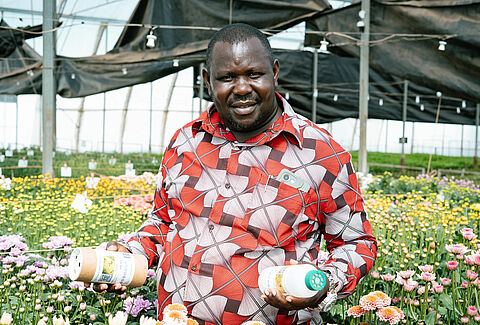
“Breeding is not fast work. Developing a single new variety can take up to seven years, involving repeated evaluation, re-evaluation, and selection cycles. Every plant is scrutinized for color, form, uniformity, performance, and market appeal.” says Fred Kisumo, Crop and Technical Manager at United Selections.
“Selection starts with clean material,” Fred explains. “If pests get in, you lose the variety before it even has a chance.”
Why IPM Was Non-Negotiable
When Fred joined United Selections about nine years ago, he made a decisive shift: to move the entire farm towards 100% IPM. The reason was simple:
- In his experience he found that harsh chemicals slowed/ retarded plant growth
- This retarded growth compromised flower quality
- Global markets increasingly demand non-toxic, residue-free flowers
“You cannot breed quality flowers with harsh products,” he says. “And you cannot meet market standards without IPM.”
The transition took years, but today, United Selections runs a fully integrated system combining:
- Cultural practices (clean greenhouses, strict hygiene)
- Mechanical and physical controls
- Compatible chemical interventions
- And biological control as the foundation
The Koppert Macros Program: Where Precision Matters
Thrips and spider mites are the farm’s most persistent challenges, particularly dangerous in the breeding and selection houses, where thousands of different plant varieties are grown in proximity.
To manage this pressure, United Selections adopted Koppert’s biological program, following extensive trials. “Before any product is adopted, we test it,” Fred explains. “Efficacy must be proven.”
The results stood out.
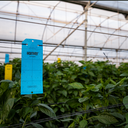
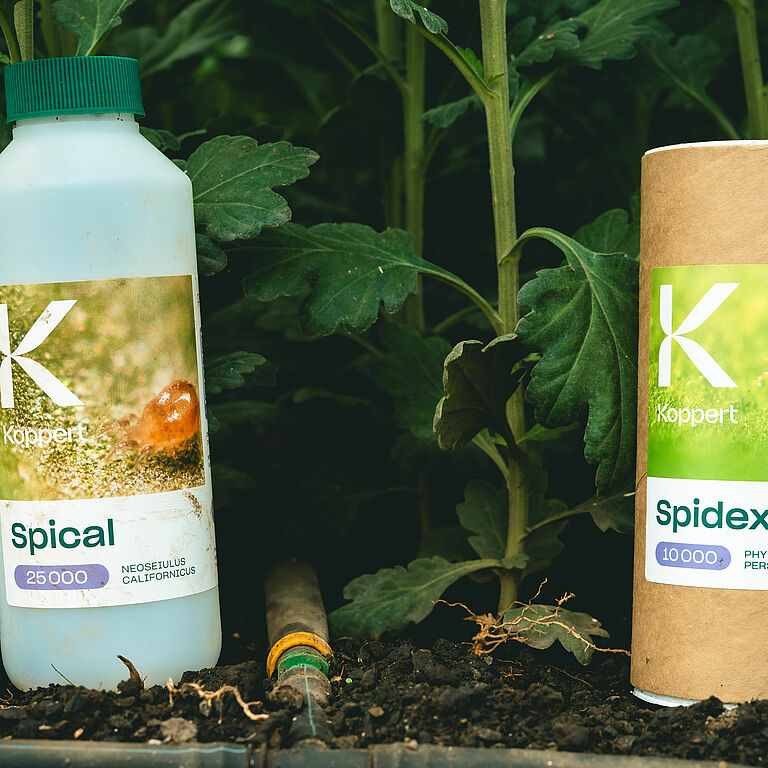
Using Koppert’s beneficial mites including Spidex (Phytoseiulus persimilis) and Spical (Neoseiulus californicus) for control of spider mite, and releasing Montdo-Mite (Transeius montdorensis) and Entomite-M (Stratiolaelaps scimitus), coupled with regular spray with Boveril (Beauveria bassiana) and mass trapping with Horiver for the control of thrips, the farm achieved consistent pest control by breaking the pest life cycle, and pest resistance to conventional pesticides.
But success depended on more than releasing biocontrol agents. IPM is not about placing mites and hoping for miracles,” Fred says. “It is about maintaining healthy ratios, scouting, timing, and appropriate climate.”
Each introduction is calculated based on pest pressure, supported by twice-weekly scouting and digital data collection. Greenhouse humidity and temperature are actively managed to favor beneficials and suppress pests.
“IPM works better with team effort”
One theme came up repeatedly during our conversation: people matter as much as products. At United Selections, the scouts are trained continuously, every worker is encouraged to report pest sightings, the staff are involved in applying beneficials and capacity training is always ongoing both internal and external – where Koppert has been instrumental.
This shared ownership ensures the program is sustained 30 days a month.
Protecting Innovation, The Koppert Way
Over time, United selections has expanded the area under Koppert’s biocontrol program to include the most sensitive breeding and selection houses.
Why?
- Strong efficacy under high pressure
- Reduced need for corrective chemical sprays
- Technical support and transparency
- Willingness to adapt, train, and collaborate
“Yes, IPM is an investment” Fred admits honestly. “But the real question is — does it work? And does it reduce other costs?”
For United Selections, the answer was yes.
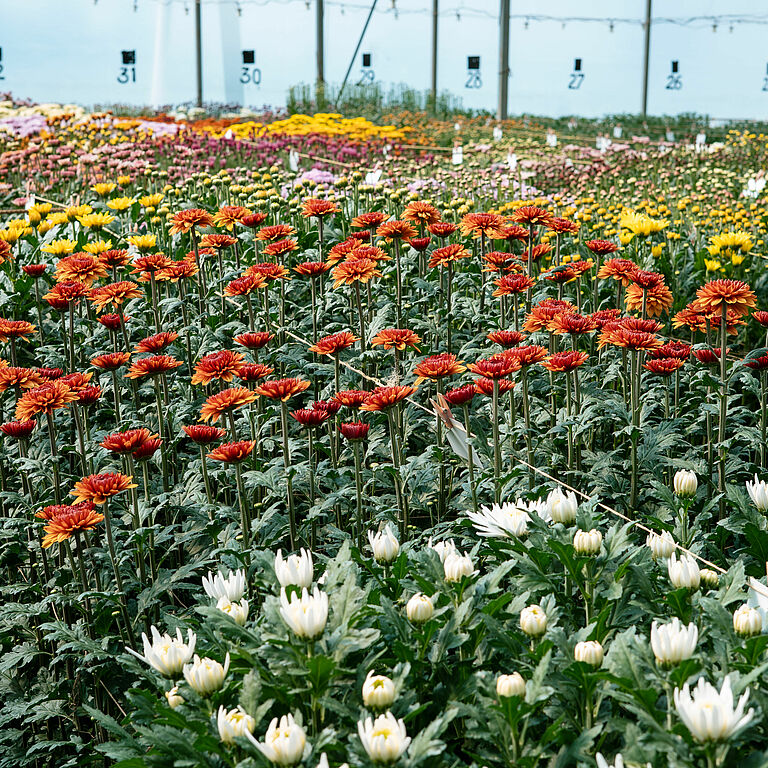
In breeding houses where varieties are closely guarded, the absence of thrips, whiteflies and spider mites is both impressive and essential. When walking through selection blocks filled with vibrant, healthy blooms, one thing is clear: IPM is not a constraint here but an enabler of innovation.
United Selections is a good example proving that biological pest control is not a trend, it is a system and a discipline.