Skip to content

General

Persea mite (Oligonychus perseae) a key pest in avocado production worldwide. It lives and feeds on the undersides of avocado leaves, where it forms small webbed feeding colonies that cause significant leaf damage and can reduce photosynthesis, fruit yield, and tree health when left unmanaged.

Learn more about

Damage symptoms

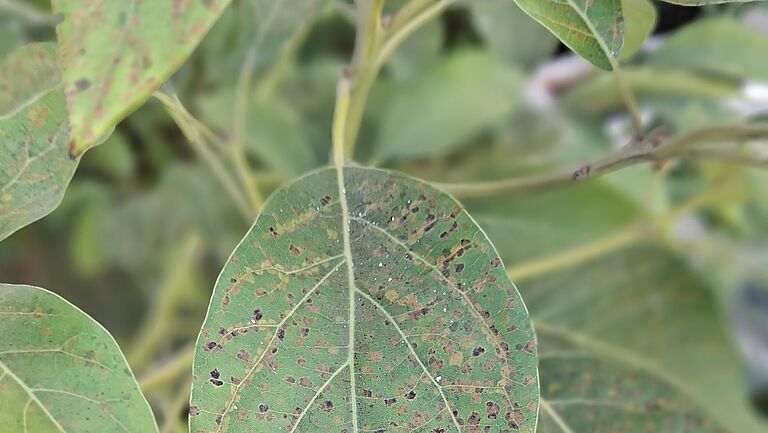
Persea mite feeding causes characteristic damage on avocado leaves, primarily on the underside where the mites form small, web-covered colonies along the main veins. Their feeding punctures the leaf tissue, resulting in small, round necrotic spots that can merge into larger brown or bronze patches as the infestation increases. Affected leaves lose chlorophyll, reducing photosynthesis and overall tree vigour. In severe cases, extensive damage leads to leaf yellowing, premature leaf drop, and canopy thinning, which can expose fruit and branches to sunburn and ultimately reduce yield and fruit quality.

Life cycle

The persea mite has a fast life cycle, allowing populations to build up quickly in avocado crops when conditions are favourable. The pest develops through egg, larval, nymphal and adult stages, with all life stages mainly occurring on the underside of avocado leaves within protective webbing. Female persea mites lay their eggs along the leaf veins, where larvae hatch and begin feeding shortly after emergence. Depending on temperature, the life cycle from egg to adult can be completed in as little as two to three weeks, resulting in multiple overlapping generations during the season. Warm, dry conditions strongly promote persea mite development, making early detection and integrated pest management essential for sustainable avocado production.

Need help?