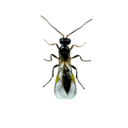
undersides of the leaves. This species of thrips is relatively large. Both males and females are dark brown to black in colour with orange pigmentation between
18 to 19 mm in length and have a wingspan of about 40 mm. The grey-green males are smaller. The forewings are edged with a line of black spots, and the
front of the wingtip has a blackish marking, which is more pronounced in the male. The hindwings are whitish, with a brown leading edge. Adults are only active
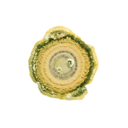
in colour, wedge-shaped and very small (roughly 0.17 mm in length), with males being slightly smaller than the females.
reduced to slender threadlike structures that are not used for walking. The males are smaller than the females and their hind legs are modified and used to
shield, brown legs, and brown mouthparts. The females are larger than the males, and have a white stripe on the rear end of the body. The eggs, larvae, and
remarkably long abdomen bends upward almost vertically, with the abdomen of males often being longer than that of females. Another distinctive feature is the
with green compound eyes and red ocelli, measuring about 0.75 mm, while males are slightly smaller, dark yellow to brown, with distinguishing antennae
PHERODIS pheromones used with TUTASAN WATERTRAPS attract and capture many male adults. This slows down the growth of the population. Deploy 20 to 40 traps
hand are crucial in monitoring and mass trapping of the adult Tuta absoluta male moths. This strategy helps in early detection of the pest and curbs the