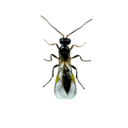
General Impatiens thrips (Echinothrips americanus) is an increasing problem in greenhouse cultivation, having spread to many countries within the last 30 years. The thrips have mostly been able to spr
General The tomato leaf miner (Tuta absoluta), a major pest of field- and greenhouse-grown tomatoes, belongs to the family of Gelechiidae . It is oligophagous, feeding mainly on Solanaceae species . T
General Two-spotted spider mite ( Tetranychus urticae ) is a pest of many crops throughout the world. Despite their small size, they are capable of very rapidly doing severe damage, due to their great
General The tobacco whitefly ( Bemisia tabaci ) belongs to the family Aleyrodidae , and the sub-family Aleyrodinae . This insect was first identified on tobacco in Greece in 1889, hence the name tabac
General The greenhouse whitefly ( Trialeurodes vaporariorum ) is one of the major pests of vegetable and ornamental crops in greenhouses throughout the world. The greenhouse whitefly ( Trialeurodes va
General The obscure mealy bug ( Pseudococcus viburni ) (formerly known as Pseudococcus affinis) originates from South America, but can now be found in many parts of the world with a temperate climate.
General The citrus mealybug ( Planococcus citri ) has a world-wide distribution and many and diverse host plants. In temperate regions of the world this mealybug poses a problem in greenhouse horticul
General The American serpentine leaf miner ( Liriomyza trifolii ) originates from North America, but occurs also in Europe since about 1976. The American serpentine leaf miner ( Liriomyza trifolii ) i
General The onion thrips (Thrips tabaci) is distributed throughout the world. It is found outdoors on many plants and particularly damaging on onions, leek, and in greenhouses on cucurbits, tomato, sw
Overview It is a pest of huge economic importance, which initially affected potatoes and in recent years has become a problem for other Solanaceae crops such as tomatoes, peppers, aubergines, and toba